
Best overall: medium double-wall cartons. Best for books: small cartons. Best for reusing what you have: clean, dry cartons with intact seams. For a Cape Town house move in 2026, choose boxes by their contents and handling needs, then confirm who supplies and packs them before accepting a removal quote.
- Moving boxes Cape Town households choose should match the contents: medium cartons for general packing, small cartons for books.
- Execumove provides packing and furniture removals; ask what your quote includes before buying cartons.
- Wardrobe cartons suit hanging clothes; divided cartons keep wrapped glasses separated.
- Reject damp, crushed or weakened cartons, even when they look usable from the outside.
Why box choice matters before you request a quote
Your packing plan affects what you need from a removal company. If you pack everything yourself, you need suitable cartons, protective materials and clear labels; if you want packing included, the quote needs to describe that work.
Execumove is a suitable option for households seeking packing and furniture removals together. Discuss your room inventory, fragile items and access arrangements with Execumove before deciding which materials to source yourself.
For your 2026 move, compare the packing scope as carefully as the transport scope. A quote that includes packing materials is not the same as one that covers transport only, and the difference needs to be clear in writing.
What makes the best moving boxes for Cape Town homes?
Choose cartons against these criteria before choosing a pack size or accepting a mixed bundle:
- Condition: Reject damp board, torn handles, crushed corners and separating seams. Previous use is less important than the condition of the carton now.
- Loaded weight: Match the box to its contents. Small cartons help keep dense items manageable; a large carton is not an invitation to fill it with books.
- Fit: Choose a carton that leaves room for protection without leaving contents loose. Oversized boxes need more void filling.
- Closure: The top and bottom must close properly. Bulging flaps indicate that you need to repack rather than add more tape.
- Handling: Check that the packed carton can be gripped and moved safely. Follow any manufacturer's stated load limit.
- Packing responsibility: Agree who supplies materials, wraps fragile items, seals cartons and labels them. Do not assume these tasks are included.
Moving boxes at a glance
These are box types, not a ranking of retailers or unverified product ranges. Each earns its place through a different household packing task.
| Rank and box type | Best for | Standout feature | Key limitation |
|---|---|---|---|
| 1. Medium double-wall carton | General household packing | Two corrugated layers in the board construction | Can still become too heavy or fail if overloaded |
| 2. Small book carton | Books and other dense belongings | Smaller capacity helps control loaded weight | Requires more cartons for bulky items |
| 3. Wardrobe carton | Clothes kept on hangers | Hanging rail reduces folding | Bulky and unsuitable for dense contents |
| 4. Divided fragile-item carton | Wrapped glasses and similar pieces | Compartments separate individual items | Dividers do not replace protective wrapping |
| 5. Sound reused carton | Selected light, non-fragile belongings | Makes use of suitable cartons you already have | Condition and construction vary |
1. Medium double-wall cartons: best for general household packing
A medium double-wall carton is the default choice for mixed household packing. Use it for belongings such as folded linen, cushions and individually protected household items, while checking the finished weight as you go.
Double-wall describes the board construction, not a promise that every carton can carry the same load. Dimensions, board specification, condition and packing method still matter.
Medium double-wall carton pros:
- A practical starting point for packing across several rooms.
- Regular shapes make room-by-room labelling straightforward.
- Matching carton footprints help you organise packed belongings.
Medium double-wall carton cons:
- Dense contents can make a medium carton difficult to handle.
- Strong board does not prevent movement inside a poorly packed box.
Best for: General household belongings that fit without forcing the flaps or creating an awkward lift.
Ask your removal company which carton dimensions fit its packing approach. Buying a large bundle first can leave you with unsuitable sizes and an unnecessary repacking job.
Verdict: Buy as your main carton type, then add specialist boxes only where the contents justify them.
2. Small book cartons: best for books and dense belongings
Small cartons help you divide heavy belongings into more manageable loads. They suit books and other compact items that would make a larger box cumbersome before it was full.
Pack books so they sit securely without bending covers or forcing the carton out of shape. Keep especially valuable or delicate editions separate for an individual packing discussion.
Small book carton pros:
- Limits the space available for dense contents.
- Makes it easier to separate books by room or shelf.
- Helps avoid the temptation to fill a large carton with heavy items.
Small book carton cons:
- More cartons mean more labels and individual handling.
- A small carton can still be overloaded.
Best for: Books, files and compact belongings whose weight builds up quickly.
Do not judge the packed weight by the empty carton's size. Follow the carton's load guidance and stop packing when it becomes difficult to handle safely.
Verdict: Buy for dense belongings; skip large cartons for a full load of books.
3. Wardrobe cartons: best for clothes kept on hangers
A wardrobe carton holds hanging clothes on an internal rail. It suits garments you want to keep hanging between wardrobes rather than fold into ordinary cartons.
Check the assembled dimensions and rail arrangement before choosing one. Long garments need enough hanging space, and the carton must still pass through the route out of your home.
Wardrobe carton pros:
- Keeps suitable garments on their hangers during packing.
- Reduces folding for clothes that you prefer to hang.
- Makes it easier to group hanging clothes by wardrobe or person.
Wardrobe carton cons:
- Occupies more space than a folded-clothing carton.
- The rail and base are not a reason to add heavy items underneath.
Best for: Hanging garments that justify a dedicated carton.
For your 2026 packing list, separate clothes that need hanging from clothes you are happy to fold. That decision helps you request an appropriate mix rather than treating every garment alike.
Verdict: Buy for selected hanging clothes; skip for clothing that packs comfortably in ordinary cartons.
4. Divided cartons: best for individually wrapped glasses
Divided cartons use inserts to separate contents into compartments. They suit glasses and similar fragile pieces when the compartment dimensions match the wrapped items.
The divider creates separation; it does not provide every part of the protection. Wrap each item appropriately, cushion the base and prevent movement without forcing pieces into tight cells.
Divided carton pros:
- Keeps individual wrapped pieces in separate spaces.
- Makes the packing arrangement easier to inspect before sealing.
- Helps organise sets without placing loose glassware together.
Divided carton cons:
- Fixed compartments do not fit every shape or stem height.
- Inserts can create false confidence if wrapping is inadequate.
Best for: Glassware that fits the compartments with room for protective material.
Ask Execumove about packing fragile items when requesting your household removal quote. Explain which pieces concern you and ask how the proposed packing scope addresses them; careful handling should be a specific conversation, not an assumed guarantee.
Verdict: Buy when the inserts fit your wrapped glassware; skip mismatched compartments.
5. Sound reused cartons: best for selected light belongings
Reused cartons belong on the list only after inspection. Choose clean, dry examples with intact corners, sound seams and flaps that close fully.
Suitable cartons can hold selected light, non-fragile belongings. Reject cartons with contamination, persistent odours, water damage or softened board rather than trying to rescue them with extra tape.
Reused carton pros:
- Makes use of suitable packing materials already in your possession.
- Works for light belongings when the carton remains sound.
- Lets you reserve specialist cartons for items that need them.
Reused carton cons:
- Previous handling and load history are often unknown.
- Mixed sizes make orderly packing and stacking harder.
Best for: Light, non-fragile contents in cartons that pass a condition check.
Remove or cover old address details and misleading labels. Mark the new destination room clearly so an old kitchen label does not send bedroom linen to the wrong place.
Verdict: Hold until inspected; use sound cartons selectively and skip damaged ones.
How these box types were ranked
The ranking follows condition, loaded weight, fit, closure and handling. Medium double-wall cartons take the general-packing slot; the remaining types answer specific needs rather than competing as interchangeable alternatives.
This 2026 guide ranks packing applications, not laboratory-tested carton models. Check the specifications of the actual cartons you choose, particularly load guidance, dimensions and any assembly instructions.
Build a packing list before buying boxes
Start with the contents, not a guessed total. A room with books and glassware needs a different carton mix from a room containing mainly bedding.
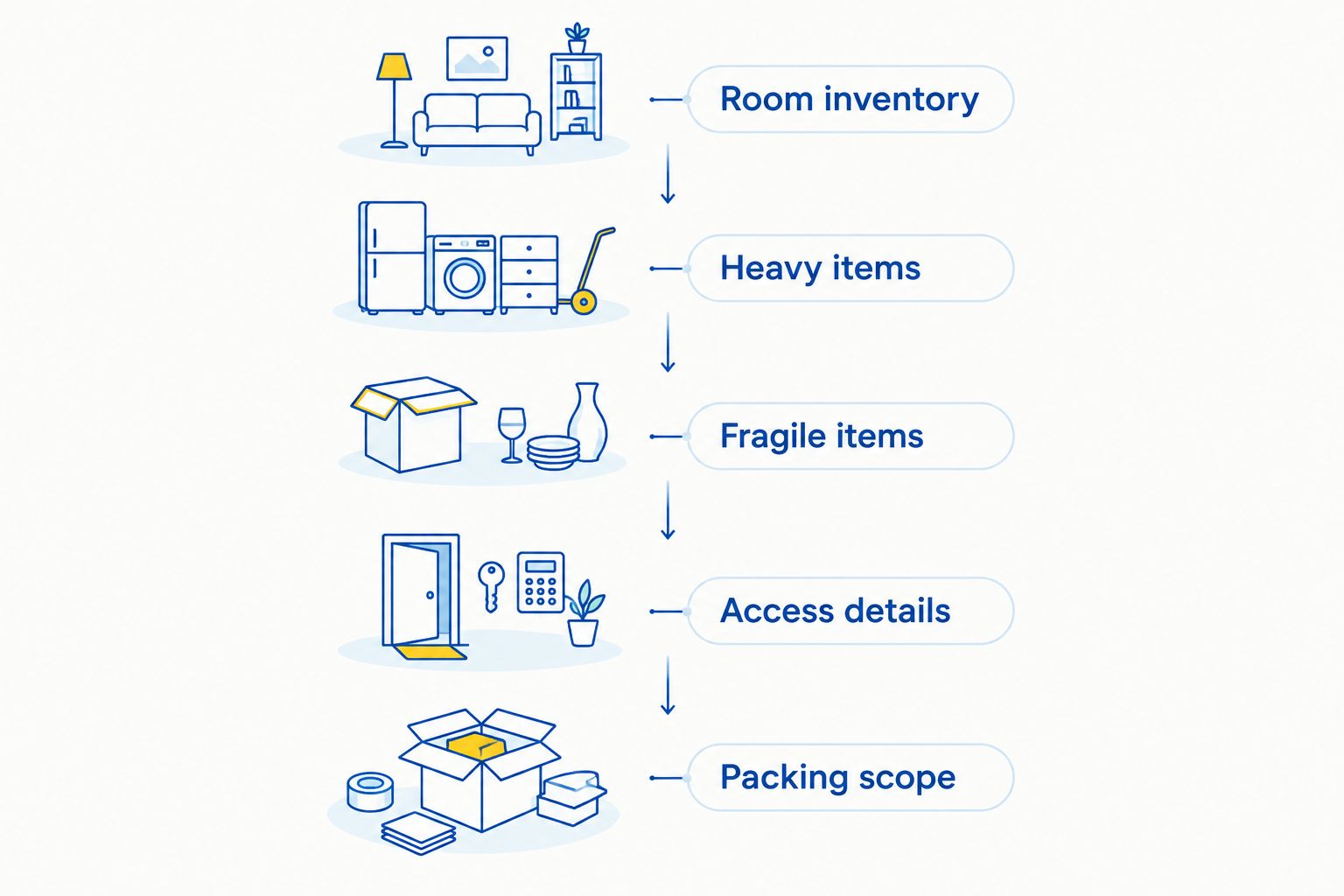
Use this sequence to turn a household walk-through into a useful quote request:
- Room inventory: List what is moving, staying, being donated or being disposed of. Finish 1 room at a time so cupboards and shelves are not missed.
- Heavy items: Identify books, files and other dense contents. Allocate smaller cartons rather than putting everything into one general size.
- Fragile items: List glassware, delicate ornaments and unusual shapes. Separate items you want professionally packed.
- Access details: Record information for both addresses. Include stairs, lifts, parking restrictions and the route between the vehicle and the entrance.
- Packing scope: Decide what you will pack and what you want the removal company to pack. Request written confirmation of the division.
For awkward access, take 3 photos: the parking area, the entrance route and the tightest doorway or staircase. Send them with an explanation of what each image shows, then ask whether an assessment is needed.
Keep a separate list for belongings that will travel with you rather than inside the removal load. Documents, keys and essential personal items need a deliberate plan, not a last-minute search through sealed cartons.
What to ask about packing in your removal quote
A clear 2026 quote should let you distinguish materials, packing work and transport. Give each company the same inventory and access details so you are comparing the same job.
Ask these questions before agreeing to the work:
- Which carton types and packing materials are included?
- Who packs fragile items, and what preparation is expected from you?
- Are dismantling and reassembly included where needed?
- How are owner-packed cartons recorded and handled?
- What cover applies, and what exclusions or conditions need your attention?
- What happens if the inventory, dates or access arrangements change?
- If storage is needed, how does that change packing, handling and delivery arrangements?
Execumove provides packing, storage and furniture removals. Request the particular combination your household needs rather than assuming every service forms part of every quote.
Discuss your household packing needs
Explain your inventory, fragile items and access arrangements before agreeing to the packing scope.
Which moving boxes should you choose?
Choose medium double-wall cartons for general packing, then use smaller or specialist cartons where the contents demand them. That is the clearest starting point for an undecided household.
For a local or long-distance move in 2026, avoid treating carton choice as separate from the removal plan. Confirm the proposed materials, who packs each category and how the packed contents will be identified at delivery.
FAQ
What are the best moving boxes for a Cape Town house move?
Medium double-wall cartons are a practical default for general household packing. Use small cartons for dense belongings and specialist cartons where hanging clothes or fragile glassware need a different arrangement.
Should I use small or large boxes for books?
Use small cartons for books to help control the loaded weight. Follow the carton's stated load guidance and avoid filling a large carton with dense contents.
Can I use second-hand boxes for moving house?
Yes, if the cartons are clean, dry and structurally sound. Reject softened board, crushed corners, separating seams and contaminated cartons, and reserve suitable reused boxes for selected light belongings.
Do wardrobe boxes make sense for every item of clothing?
No, wardrobe cartons suit clothes you want to keep on hangers. Fold suitable clothing into ordinary cartons and check that any wardrobe carton fits the garments and access route.
Do glass dividers replace wrapping?
No, dividers separate items but do not replace protective wrapping and cushioning. Check that each wrapped piece fits its compartment without pressure or loose movement.
How many moving boxes will I need?
Build a room-by-room inventory before deciding on quantities. Ask the removal company to assess the contents and proposed packing scope rather than relying only on the number of bedrooms.
Can Execumove help with packing as well as furniture removals?
Yes, Execumove provides packing and furniture removal services. Ask which materials and packing tasks are included in your specific quote, especially for fragile items or belongings going into storage.
One last thing
Label cartons for where they are going, not only where they came from. A box packed in a spare room might belong in the new study, and a clear destination label removes that ambiguity.
Before sealing each carton, check that its contents match the label and that the flaps close without pressure. The best box is the one that suits its contents and remains manageable when packed.