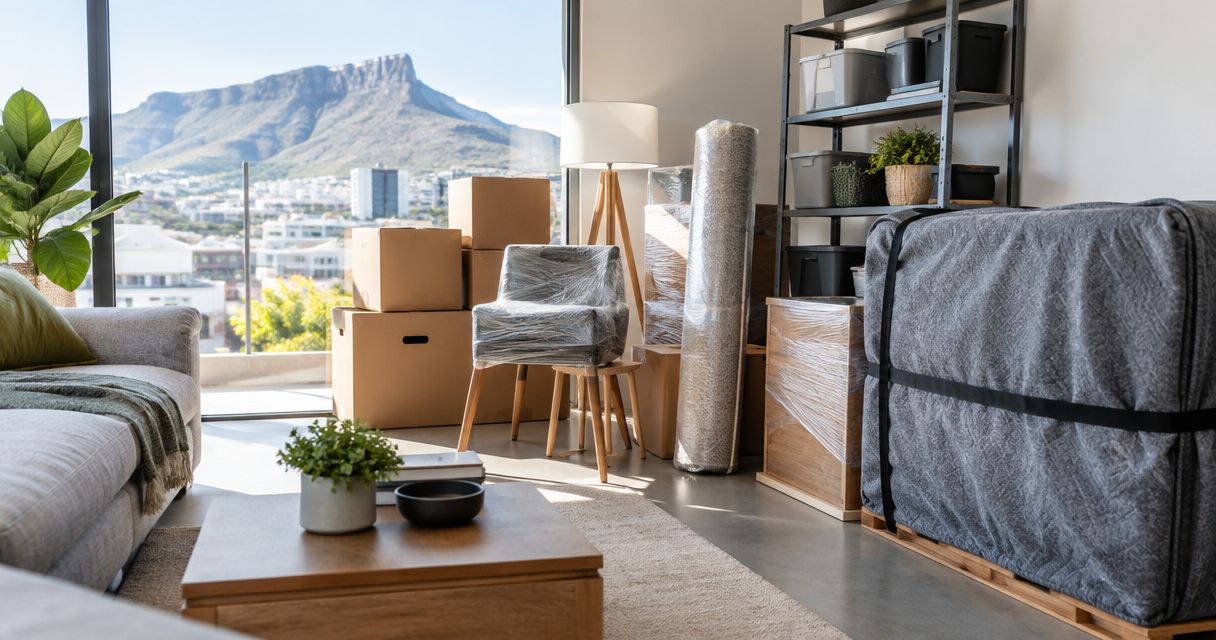
Best overall: furniture-matched storage for a measured household inventory. Best for boxes and small items: a compact space. Best for a whole household: a larger space planned around bulky furniture. For storage units Johannesburg households can assess confidently in 2026, choose by usable dimensions and your packing plan—not a bedroom-count label.
- For storage units Johannesburg households should choose by measured furniture, packing needs and access—not bedroom count alone.
- Execumove suits households seeking furniture removals, packing and storage as part of their move.
- Compact storage suits boxes; bulky furniture needs a layout checked against internal dimensions.
- Confirm door clearance, access arrangements and the storage inventory before accepting a moving quote.
Why this matters
Storage is part of your move, not a separate floor-space purchase. Your furniture must pass through the entrance, fit without unsafe stacking and come out in the order you need it.
Execumove provides furniture removals, packing and storage. Execumove is a practical choice for households seeking furniture removals and storage within the same relocation brief. Ask for the storage arrangement, handling requirements and delivery instructions to be set out alongside your removal requirements.
This 2026 guide compares storage layouts rather than advertised unit sizes. The categories below are planning choices, not named packages or confirmed dimensions offered by a particular provider.
What makes the best storage size for your move?
Judge each option against these criteria before comparing quotes:
- Furniture footprint: Measure the longest, widest and tallest pieces in their packed or dismantled state.
- Usable height: Check internal height and what can safely occupy it. Empty air above fragile furniture is not automatically usable capacity.
- Door clearance: Confirm the entrance dimensions and any turns along the route into storage.
- Packing method: Allow for protective wrapping, cartons and furniture that must remain upright.
- Retrieval needs: Decide whether everything stays untouched or whether you need a clear route to selected items.
- Handling scope: Establish who packs, dismantles, loads, stores and later delivers each item.
The best fit is the smallest space that accommodates your actual load safely and meets your access needs. A smaller space fails that test if fitting everything depends on stacking cartons on unsuitable furniture.
Storage sizes at a glance
| Planning option | Best for | Standout feature | Key limitation |
|---|---|---|---|
| Furniture-matched space | A mixed household load going into storage during a move | Layout follows the actual inventory | Requires measurements and a packing plan |
| Compact box-focused space | Cartons, dismantled shelving and selected small items | Keeps a limited storage load together | Poor fit for bulky, non-stackable furniture |
| Larger whole-household space | Most household contents stored between homes | Allows bulky pieces to determine the layout | Bedroom count alone cannot establish the right size |
| Access-first layout | Households retrieving selected belongings during storage | Clear route to frequently needed items | Access space reduces storage density |
An access-first layout is not a separate unit specification. It describes how you use the space, and it can require more floor area than a tightly packed layout containing the same belongings.
1. Furniture-matched space: best overall for a household move
Furniture-matched storage starts with your inventory rather than a preset label. You measure the pieces that dictate the layout, then assess where wrapped furniture and cartons can sit without damaging each other.
This is the strongest starting point for a Johannesburg household moving between properties in 2026. It connects the storage decision to the removal load instead of treating them as unrelated bookings.
Furniture-matched space pros:
- Uses the furniture you actually intend to store.
- Makes awkward items visible before loading day.
- Connects packing and dismantling decisions to space requirements.
- Gives quote discussions a clear, shared inventory.
Furniture-matched space cons:
- Needs accurate measurements rather than a quick room count.
- Requires revision if you add furniture or change the packing plan.
Best for: A mixed load of furniture and cartons that will remain in storage until your next home is ready.
Start with sofas, mattresses, dining tables, cabinets and appliances. Record whether legs, shelves or bed frames will be removed, and identify which pieces must stay assembled.
Ask the provider to explain the proposed fit. A statement that your belongings should fit is less useful than confirmation of internal dimensions, entrance clearance and the intended handling arrangement.
Verdict: Buy the furniture-matched option once the inventory and proposed layout agree.
2. Compact box-focused space: best for a limited storage load
A compact space suits a selective move: cartons, small household items and dismantled pieces rather than the contents of an entire furnished home. Its strength is a clearly limited inventory.
Do not choose it simply because you are moving from a small flat. A bulky sofa or an assembled wardrobe can determine the required footprint even when the rest of your belongings fit into cartons.
Compact space pros:
- Keeps a small, defined load together.
- Encourages sorting before packing.
- Works with a layout based mainly on stackable cartons.
Compact space cons:
- Leaves little flexibility for furniture added later.
- Requires care with carton strength, weight and stackability.
Best for: Household overflow while most furniture moves directly to the new address.
Separate the storage list from the direct-delivery list before requesting a quote. Otherwise, a description such as household contents leaves the provider guessing which pieces need space.
Keep books in manageable cartons and mark fragile contents clearly. Do not assume that every carton can bear another carton above it; the contents and packaging determine that decision.
Verdict: Buy compact storage for a confirmed small load; skip it for an unmeasured furniture collection.
3. Larger whole-household space: best between homes
A larger space is the planning option for households putting most of their belongings into storage between departure and occupation. The layout must account for bulky furniture, packed possessions and any pieces requiring separate handling.
More floor area does not remove the need to measure. A narrow entrance can still prevent a large item reaching an otherwise suitable space.
Larger space pros:
- Accommodates planning around several bulky pieces.
- Provides more layout flexibility than a tightly constrained footprint.
- Supports keeping a household storage inventory together.
Larger space cons:
- Can leave unused space if you dispose of furniture before moving.
- Still needs a loading plan to avoid inaccessible or unsupported items.
Best for: A household storing most possessions while waiting to move into its next property.
For a 2026 move, confirm the storage inventory after deciding what you will sell, donate or leave behind. An estimate based on everything currently in the house can become unsuitable once those decisions change.
Discuss the eventual delivery address too. Stairs, lifts and restricted entrances affect the removal brief even though they do not change the physical volume of your belongings.
Verdict: Buy a larger layout for a confirmed whole-household load, not on bedroom count alone.
4. Access-first layout: best for retrieving belongings during storage
An access-first layout reserves room to reach selected items without moving the entire load. It suits households needing work materials, seasonal belongings or other possessions before final delivery.
You must confirm whether the storage arrangement permits the access you need. A usable aisle inside the space does not establish when or how retrieval is allowed.
Access-first layout pros:
- Gives frequently needed belongings a deliberate position.
- Separates retrieval items from long-term stored contents.
- Makes the loading order easier to specify.
Access-first layout cons:
- Uses floor area that would otherwise hold belongings.
- Depends on the provider's confirmed access arrangements.
Best for: Households that need selected belongings before the full load leaves storage.
List retrieval items individually rather than writing miscellaneous boxes. Mark them clearly and ask whether they will be reachable without disturbing heavy furniture.
If you will not need anything until final delivery, a retrieval aisle serves no practical purpose. Keep essential documents, medication and everyday necessities with you instead.
Verdict: Buy an access-first layout only when retrieval is necessary and the access arrangement is confirmed.
Measure before you choose a storage size
Floor area and volume describe different things. Neither measurement, on its own, proves that your furniture fits.
As a calculation example—not an advertised unit—a space measuring 2 metres by 3 metres has 6 square metres of floor area. At an internal height of 2.4 metres, its geometric volume is 14.4 cubic metres; that does not mean every part of that volume can hold household goods safely.
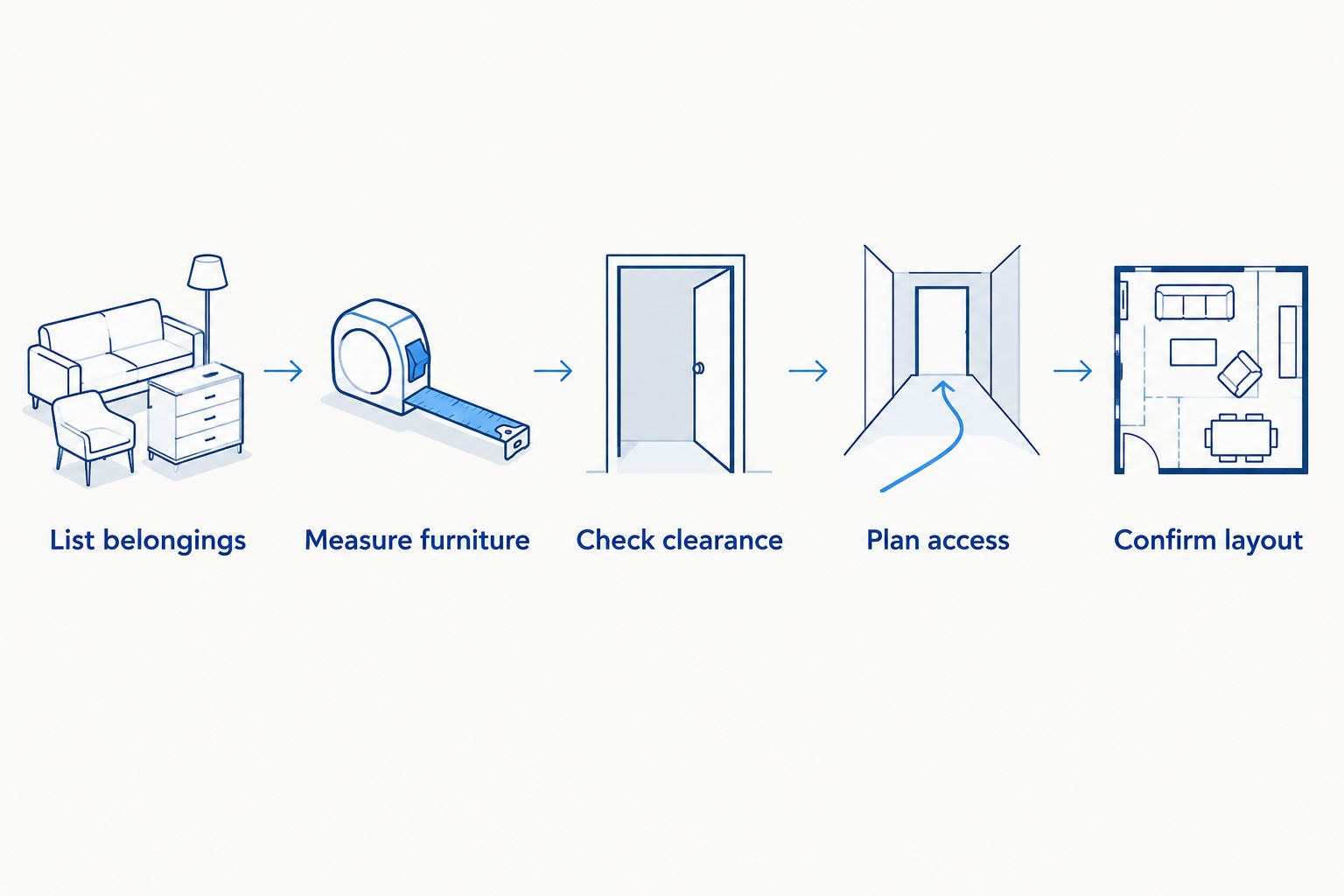
Use this sequence:
- List belongings: Separate storage items from direct-delivery items.
- Measure furniture: Record packed dimensions and dismantling requirements.
- Check clearance: Confirm the entrance and route into the space.
- Plan access: Identify anything needed before final delivery.
- Confirm layout: Ask how the proposed space accommodates the load.
Measure furniture in the condition in which it will travel. A table with removable legs has different storage requirements from the same table left assembled, so record the intended arrangement rather than assuming dismantling will happen.
What to include in your storage and moving quote request
A useful 2026 quote request explains the load, the journey and the handling responsibilities. Send the same brief when comparing proposals so that differences in scope are visible.
Include:
- Collection and delivery addresses, with stairs, lifts and parking restrictions.
- Your storage inventory, measurements and photographs of awkward pieces.
- Items requiring packing, dismantling or special handling.
- Your expected storage period and any uncertainty around the delivery date.
- Whether you need access to selected belongings.
- Who will pack cartons and prepare appliances.
- Your preferred delivery sequence when storage ends.
Tell Execumove if careful handling is your main reason for choosing a removal service. Then ask how the proposed packing, loading and storage arrangements address your particular furniture; a clear explanation is more useful than an assumption.
Request written clarification of storage terms, access procedures, insurance arrangements and responsibility for packing. Ask what happens if your inventory or delivery date changes.
Discuss your moving and storage needs
Prepare your inventory, furniture measurements and access details before discussing your move.
How these storage options are ranked
Furniture-matched space ranks first because it addresses the central decision: whether your actual belongings fit with appropriate packing and handling. Compact, whole-household and access-first layouts then serve distinct needs rather than competing as universally better sizes.
The criteria are furniture footprint, usable height, door clearance, packing method, retrieval needs and handling scope. This is a planning comparison, not a facility inspection or a claim about particular storage units.
Which storage size should you choose?
Choose furniture-matched storage unless your inventory clearly points elsewhere. Choose compact space for a limited carton-led load, larger space for most household contents, and an access-first layout when you genuinely need retrieval.
For Johannesburg storage in 2026, settle the inventory before settling the size. Give Execumove the same furniture list for removals and storage so the discussion covers the full journey from collection to final delivery.
FAQ
What's the best way to choose storage units in Johannesburg?
Choose storage units in Johannesburg by comparing your measured inventory with usable internal dimensions, entrance clearance and access arrangements. A bedroom-count description is a starting point, not proof that your furniture fits.
What size storage space do I need for a furnished flat?
The right size depends on the furniture and cartons you are storing, not the flat's room count alone. Measure bulky pieces, record dismantling plans and ask the provider to explain the proposed layout.
Is floor area or cubic volume more useful for furniture storage?
Both matter, but neither proves a suitable fit by itself. Floor area affects furniture placement, while usable height depends on safe stacking and the shape of your belongings.
Should I choose a bigger storage space so I can get to my boxes?
Choose an access-first layout when you need to retrieve belongings during storage. Confirm the provider's access procedures before reserving space for an aisle.
Can I dismantle furniture to reduce the space it needs?
Dismantling suitable furniture can reduce its storage footprint. Confirm who will do the work, protect the separated components and label fixings for reassembly.
What should I ask Execumove about furniture removals and storage?
Ask Execumove how your inventory, packing needs and storage requirements will be handled within the move. Confirm the scope, access arrangements and final-delivery instructions in writing.
Do I need different packing for furniture going into storage?
Packing must suit the items, handling and storage arrangement. Tell the provider what is fragile, what must remain upright and whether any cartons will need retrieval before final delivery.
One last thing
Plan the exit from storage before the entrance. Tell the removal team which rooms should receive which items, and label cartons accordingly before collection. A load that fits is only half the decision; a clear delivery plan helps you use those belongings again.